Posts

Showing posts with the label digital subscriptions

Users will own the media: how journalism is evolving
Image
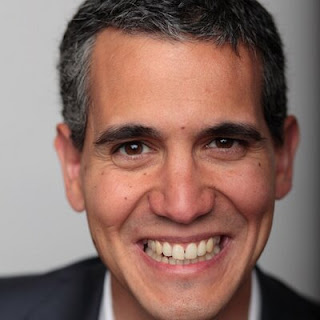
Alfredo Trivi�o has worked largely behind the scenes on some of the biggest digital media projects for some of the biggest brands in the world. But you might not have heard of him. Alfredo Trivi�o: users will own the media, in every sense He spent seven years in senior management roles at News Corp., ultimately as director of innovation, where he worked on development of a pay model for digital journalism and on long-term editorial and commercial growth strategies. (He is a 1999 graduate of the University of Navarra School of Communication, where I teach.) He was invited to give the closing keynote address last week to the annual conference of the Spanish Journalism Society (SEP, Sociedad Espa�ola de Period�stica). He ruminated casually about trends he sees in the worlds of digital journalism and digital commerce, mixing some English terminology into his Spanish presentation. Among the shifts he sees: A shift from journalism and commerce to journalism vs. commerce. That is, the...
How Talking Points Memo has converted from an ad model to paid subscriptions

Image
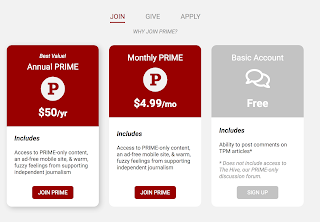
Readers now supply more than half the site's revenue. Josh Marshall started out as a political blogger in 2000, made a business of it in 2003, won a George Polk Award, and has managed to stay independent through all the wild swings of the digital pendulum. So his reflections on how to transition from an advertising business model to paid subscriptions have a certain authority. He talked about the evolving business model of his site, Talking Points Memo , in a 47-minute podcast with Digiday Editor Brian Morrissey. Among Marshall's observations that are relevant to other would-be news entrepreneurs: Small, independent news sites cannot rely on scale to drive revenue. They need a strong relationship with their users. Many digital media organizations that have massive audiences will not be able to make the transition to paid subscriptions because they don't have that relationship, he believes. Many of the 26,000 paid subscribers to TPM, which are now supplying just over hal...

When they trust media less, they're willing to pay more

Image
Alfonso Vara-Miguel A new study of internet users in Spain shows that those who trust "the media" less are more willing to pay for news online. The explanation for this counterintuitive behavior is that those distrustful folks "are willing to pay for those specific media that they trust", according to the researchers, Alfonso Vara-Miguel of the Universidad de Navarra and Manuel Goyanes of the Universidad Carlos III of Madrid. ( The full text of their article is in Spanish: "The probability of paying for digital news in Spain," in El Profesional de la Informaci�n .) In other words, trust and confidence have an economic value that media organizations can monetize . Manuel Goyanes Getting people to pay Media economists like to say that the Spanish are legendary cheapskates when it comes to paying for any form of media. But the researchers believe they have identified some of the market segments most likely to pay for news . They base their conclusions o...

Slovakia is latest to prove subscription model online

Image
Home page of Dennik N Contrary to all the predictions about the public's unwillingness to pay for news when it is freely available online, more publishers of high-quality, in-depth reporting are making money. The latest example comes from Slovakia, as recounted by Rob Sharp in Nieman Lab . The editors of a popular national newspaper there discovered that a news organization tainted by corruption accusations was about to buy a significant stake in their paper. Versi�n en espa�ol Anticipating restrictions on their work, the editor, Matus Kostolny, and a team of his lieutenants decided to start an independent online news publication, Dennik N . As Sharp describes: The outlet attracted �1 million of private investment and advanced subscriptions of around �300,000. They launched their daily website in January 2015, and a printed paper shortly afterward. Now, just over two years later, they are among the top five quality newspaper websites in Slovakia. In a country of 5.4 million people,...

Readers pay for digital news when you sell the value

Image
NEW YORK -- The big mystery in the newspaper industry has been how to get digital readers to pay for a product they have been getting free for years. Denise Warren The industry has struggled because subscription operations were always loss leaders that didn't pay for themselves. Executives had no idea how to run a profitable subscription operation and have been learning how to do it for the first time, said Denise Warren , who played a major role in the New York Times 's transition to paid digital subscriptions. She spoke May 3 to an audience of professors and industry representatives at the World Media Economics and Management Conference held at Fordham University. Many publishers make the mistake of marketing their digital products on the basis of price and discounts, Warren said, when they should be promoting the unique value proposition of news and information that readers cannot get anywhere else. Read more �

Paywalls and micropayments start to gain traction

Image
The loss of advertising and the complications of public funding are forcing digital publishers to look for ways to persuade the public to pay. Surveys and actual market behavior show that a small percentage of digital users will pay, depending on the country, the media brand, payment systems, and technology platforms. For some publishers, that could be the difference between thriving and merely surviving. (Versi�n en espa�ol) The amounts some would be willing to pay are in the chart below, from Reuters Institute�s 2015 online survey of 24,000 users in 12 countries. From Newman et al., Reuters Institute Digital News Report 2015 (p. 65). Click on chart to enlarge. Read more �