Posts

Showing posts with the label university of navarra

Chasing clicks isn't bringing in readers or money

Image
Some observations by media economics expert Robert Picard's observations about the challenges of media today, from an interview done by the University of Navarra Faculty of Communication : Media companies need to develop revenue from many more sources than they did in the past. Media companies are diluting the quality of their product by chasing reader clicks with light or frivolous digital content. "This is not bringing in money, and it's not bringing in audience." Versi�n en espa�ol Maybe 15 to 25 percent of the reading public will pay for serious news, Picard says. These are the people who really want news. Journalists think their work is really important, and for the journalists, it is. But for most people, they just want to get on with their lives . If something important happens, then they will go online and read it somewhere, but most of the time they won't pay for it. Newspapers have to stop thinking of themselves as a product for a general audience. T...
Picard to publishers: get cozy with readers, users

Image
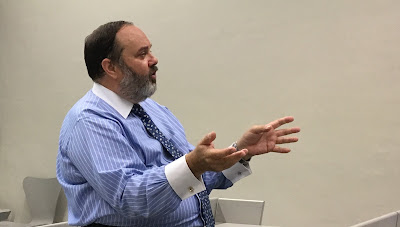
Robert Picard speaking to class at University of Navarra. Robert G. Picard is one of the founding fathers of the academic discipline known as media economics. The field has attracted more attention lately as news outlets, ravaged by digital competitors, have gutted their reporting staffs and slashed public-service coverage. Policy makers, media executives, investors, and journalists themselves look to experts like Picard for answers about how to deal with the industry's financial crisis and the diminishing supply of news. Picard admits that he is unsure of exactly what the future holds for the industry. What he does know is that the people who are running media organizations--TV, radio, newspapers, magazines, and even digital outlets--know far too little about their readers, viewers, listeners, and users. Publishers need to invite these consumers into the processes of creating and distributing content, he said. They need to think about how to create value that will satisfy the need...

A voice for free speech in a free world

Image
Marty Baron, center, with U. of Navarra faculty and students. Photo by Manuel Castells Marty Baron, editor of the Washington Post, came to speak at University of Navarra events in Madrid and Pamplona last week. Baron's message made me proud to be an American and a journalist. The whole world looks to the U.S. for leadership. Here is an excerpt from his speech in Madrid. " At the center of our mission is journalism that holds powerful institutions and individuals accountable . We have an obligation to speak truth to power. And the powerful in our world should never be allowed to suppress it. For all the challenges we face in the media today, this is the greatest. It is why we as journalists must stay faithful to our central purpose. Someone must still tell things as they really are. No government power, no powerful institution, and no powerful individual should have the right to stop us . And we in the press should not stop ourselves because of fear or self-censorship. These a...

'Take risks, learn from mistakes,' says film-maker

Image
Joff� spoke to several hundred students at the University of Navarra on Thursday . Film-maker Roland Joff� has a way of leading people on a mystical meditation to find out who they are and how they will communicate with the world. "The truth is that no one in this room actually knows where we are," he told about 400 students and professors Thursday at the University of Navarra School of Communication . "And if we don't know where we are, how on earth can we know who we are. And finding out who you are is all your journey, isn't it? "Communication is about finding out who you are and listening to other people and finding out who they are. And that's very beautiful." Joff� is best known for directing The Mission and The Killing Fields . But he holds a special interest for the University of Navarra audience because he wrote and directed There Be Dragons , a film about the founder of Opus Dei and the university, St. Josemar�a Escriv� de Balaguer . ( O...

Your career is an adventure: Be an adventurer

Image
Last week the Department of Communication at the University of Navarra invited 16 alumni with interesting career paths to share their stories with the students. I attended four of the sessions and heard a similar comment from each of the presenters: I never imagined that I would be doing the things I am doing now in my professional career. A journalism major was hired in public relations by a German automaker, partly because he learned German during a year of study abroad. Another journalism major's assignment to cover sporting events, in which he had little expertise, eventually led to assignments covering culture and entertainment, which he loves. Many unimaginable opportunities presented themselves at unexpected moments from unlikely sources. Professional life for them had been an adventure. I�aki Gabilondo, Foto de biografiasyvidas.com Versi�n en espa�ol The advice these alumni gave also ran along similar lines: You need to be flexible, learn at every stage of your career, an...

ProPublica pioneers investigative journalism for the digital age

Image
PAMPLONA, Spain -- Given all the trash, half-truths and outright lies published on digital media, people are placing a higher value on media that verify information and demonstrate high ethical standards. Paul Steiger, taking questions at U. of Navarra event Paul Steiger , founder and executive chairman of ProPublica, tells of a major donor to his online publication who "absolutely hated" an investigative story that they had published about a group "near and dear to the donor's heart". Steiger told the donor that the information was verified, and the story was fair. "We will just have to agree to disagree," he told the donor. The donor, who had given $100,000 every year, stopped giving. And that would have been the end of the story, except that a year later, with no explanation, the donor's annual check arrived again. Steiger's point was that even people who disagree with you still respect journalism with high standards of accuracy and ethics....

An exercise on usability puts theory into practice

At the end of a semester-long course in digital journalism , I asked my students at the University of Navarra in Spain to say what they thought was the most interesting or useful part of the course. The survey was anonymous, so I give it some credibility. The question was open-ended. The second-most-mentioned item was a class exercise I gave them in which they had to judge the navigability, usability, transparency , and other factors of any website they liked. This group exercise put theory into practice and developed their analytical skills . (No. 1 was the video interviews with digital media entrepreneurs from Latin America. They are in Spanish and can be seen on my YouTube channel . Accompanying text in English is available elsewhere on this blog.) The exercise took 45 minutes and followed a 45-minute lecture on the theory of Internet design, especially as it applied to taking advantage of mobile and social platforms. First, I told the students that they were going to do an ungrade...