Posts

Showing posts with the label digital communication

Where the jobs are for graduates in journalism

Image
"The new journalism specialties". The graphic shows that 56% of the Spanish journalists surveyed work in media that have community managers, and 30% employ data and traffic analysts. Click to enlarge the graphic. Where will the jobs be for graduates in journalism and communication? The results of a survey of journalists in Spain give some indication. The urgent demand is for people with digital media skills, but more on that in a minute. The Press Association of Madrid 's (abbreviated to APM in Spanish) 2017 survey was sent to 13,500 professionals, and the overall response rate was a respectable 13%. A little more than a third were working in journalism while another third were working in other professions or were retired or semi-retired. The remaining 30 percent were working in communications, mainly advertising and public relations. (News articles about the survey are here , here , and here in Spanish. Disconnect in training The survey results show that the respondent...

Time machine: the year broadband arrived

Image
Digging through some old files recently, I came across a column I wrote for the Baltimore Business Journal 22 years ago. It described how our cable TV and internet provider had installed fiber-optic cable in the neighborhood. This new distribution channel transformed a clunky dialup internet service into a lightning fast information source. The hyperbole and enthusiasm expressed in the column are slightly embarrassing for someone who prides himself on skepticism. But some of it was right on target. From PeakOptical.com Versi�n en espa�ol It began, "Public libraries could be in danger." I described how I used this new service to research an advertising client before going to a meeting with the CEO. I was the publisher of the newspaper and thus ultimately responsible for sales. The column went on to contrast the internet with a library: Read more �

Why digital networks are ruling the world

Image
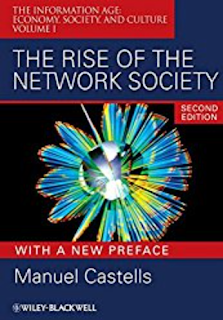
For the last few years, the name Manuel Castells kept popping up in things I read about digital media, social networks, and mass communications. He is a Spanish sociologist who spent much of his career at UC Berkeley. Recently I have been reading his "The Rise of the Network Society," the first of three volumes in a series "The Information Age." He wrote them two decades ago, but he seems to have predicted many of the trends we are living through now. The free flow of money, information, and power through global networks means those networks, not nations, are the source of power, he wrote. Institutions, societies, and ethnic groups with rigid structures that cannot take advantage of these flows will be left behind. He wrote a new preface for the 2010 edition, before the Arab Spring, before the Syrian civil war, before Brexit, before Trump. He pointed out that structural changes were taking place in society because large sections of the world's population were ...

'Communities are more important than the media' -- Jose Luis Orihuela

Image
Jose Luis Orihuela has been writing about digital media for almost 30 years. So I have been enjoying his new book, "The Media Since the Internet" ( �Los medios despu�s de Internet �), which is a compilation of his columns for newspapers in Spain and Latin America in 2011-2013. (His 159,000 Twitter followers around the world know him as @jlori. ) Orihuela, a professor and colleague of mine at the Universidad de Navarra in Spain, takes us on his intellectual voyage and shows us the courage and vision we need to navigate this sometimes scary new world of the Internet. Versi�n en espa�ol Each of these columns in the book is a like an entry in the logbook of a voyage of discovery through the uncharted waters that the new media environment represents. Like the explorers of the 15th century, Orihuela observes, processes, analyzes, speculates, and makes recommendations based on his investigations. He drops some marker buoys to help us follow his path. The result is a guide that i...

Professors of The Book, students of The Smartphone

Image
Photo from U.S. News & World Report The Internet is a revolutionary tool of communication. Because of that, teachers of communication have to face up to the possibility that our models for teaching and learning are becoming less effective and relevant. Like many of my teaching colleagues, I have complained that students don't read. Well, they do read, but in a different way. To understand the trend, we should step back and look at another communications tool that was revolutionary in its own day -- the Book. ( Versi�n en espa�ol ) For at least 500 years, research and teaching at universities has been built around the Book. We teachers of communication are still People of the Book while our students are People of the Internet . The professor and journalist Jose Cervera explains the difference (in Spanish) in a brief article called "In Praise of the User", on his blog, El Retiario (The Net Warrior), published on Spain's public television website. El Retiario com...