Posts

Showing posts with the label digital media

Smart money is betting on local, trustworthy news

Image
This blog post started out as an explanation to my friends and family in Cleveland and Columbus, Ohio, why their local newspapers had become shadows of their former selves . Why their newspapers were so thin. Why news coverage was so shallow. Why they felt like they weren't getting their money's worth. From trust to distrust in one decade. Pew . And we will get there in a minute, but first, some good news. It was heartening to see the Knight Foundation's recent announcement that it was committing $300 million over five years to strengthen journalism, from the ground up, by focusing on local news and on encouraging collaboration. �We�re not funding one-offs. We�re helping to rebuild a local news ecosystem , reliable and sustainable, and we�re doing it in a way that anyone who cares can participate,� said Alberto Ibarg�en, Knight Foundation president. Gradually, civic minded individuals and organizations have realized that the loss of local news coverage threatens...


When government fails, 'business has to step up'

Image
Businesses like to devote part of their marketing and public relations budget to promote how they are giving back to society . We are not just about profits, they try to say. And the message is arguably true, not just propaganda, as far as it goes. Fink, from BlackRock.com But we are starting to hear a different kind of message from business people, and it goes like this: "Around the world, frustration with years of stagnant wages, the effect of technology on jobs, and uncertainty about the future have fueled popular anger , nationalism , and xenophobia . In response, some of the world�s leading democracies have descended into wrenching political dysfunction, which has exacerbated, rather than quelled, this public frustration. Trust in multilateralism and official institutions is crumbling. " -- Larry Fink, (emphasis mine) Business people will have to fill the gap left by polarized and paralyzed national governments: this is the message of Larry Fink, CEO of BlackRock ...

Innovation studies go back to the future

Image
Predicting the future has always been a dangerous business in the creative industries . As any economist will tell you, products like books, movies, TV shows, and music are "experience goods", which can only be evaluated after they are purchased or experienced. Making predictions or recommending strategies is especially difficult now with rapid technological change disrupting every creative industry. This theme appeared in several of the presentations at the Creative Industries and Media Management Conference held at the University of Porto, Portugal, Sept. 19-21. The conference was organized by Paulo Faustino of Porto and Nova universities. -- Michal Glowacki , professor of journalism at the University of Warsaw, presented preliminary findings from a study of the dynamics of organizational culture in public media that identified success factors in what he calls creative media clusters . Read more �

100 digital news startups in Latin America show paths to achieving sustainability

Image
A new study of 100 digital news startups in Latin America by SembraMedia in partnership with Omidyar Network -- Inflection Point -- offers many clues to achieving the elusive goal of sustainability. Extensive interviews with the founders -- 25 each from Argentina, Brazil, Colombia, and Mexico -- produced data that clarified the elements of successful business models and showed the best places to invest resources and training. Janine Warner , co-founder of SembraMedia and an ICFJ Knight Fellow, directed the study, which was managed by her co-founder, Mijal Iastebner. (Disclosure: I participated in the study as an editor.) Among the insights: You don't need a lot of money to get started. 71% of the media in this study had startup capital of less than $10,000, but a tenth of those now generate at least $500,000 in revenues (p. 8). Those that focus on business development do best. Those with at least one sales person reported median annual revenues of $117,000; those with no sales ...

Newsstand owner adapts to survive media crisis

Image
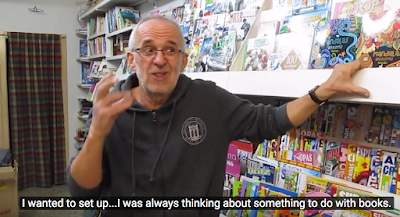
Newsstand owner Jesus Erro: Publishers are fudging their sales numbers. PAMPLONA, Spain - Those who study the business of media tend to look at it from the perspective of journalists and publishers. But the owner of a newsstand in the heart of this provincial capital has a different point of view. Jesus Erro, 56, has owned and operated Caprichos Books and Stationery for the past 24 years. He has seen the good times and the bad. For the first decade or so, sales of magazines and newspapers -- about three fourths of his business -- were strong. But beginning in 2008, with the combination of the financial crisis and the Internet's impact on sales of print products, the business has gone down steadily. Versi�n en espa�ol "For small shops in this industry, it's very difficult to survive. A few years ago, when there was a favorable economic climate, everything was straightforward, more or less. You never expected to make a lot of money but you did expect to make a decent income...

"It's not students with smartphones but professors' teaching methods that are to blame"

Image
I want to share with you my translation of a blog post (Spanish) by my friend and colleague Jose Luis Orihuela, a professor at the University of Navarra, author, and keynote speaker. Orihuela is addressing a problem that faces many teachers and professors: they say their students are distracted by all the media on their smartphones and are not paying attention in class. Don't blame the students, he says. Blame the professors . "It has to be said again: the problem is not that the student is distracted by technology but that the professors have to change their methods and the content of their teaching. "It's easy to place the blame on the students and their devices; the hard thing to do is redesign education to adjust to a culture of connectivity. You can't teach against the culture of the students. You have to build on top of it." He mentioned a well publicized column by a professor in Uruguay who decided to throw in the towel rather than fight against stu...

Forget about the big numbers; go for loyalty, trust

Image
Anyone who has studied the metrics of the internet in any detail knows about the Big Lie : those big numbers of total users and page views that everyone relies on are practically meaningless . More than half of the visitors to websites stay for less than 15 seconds . Three-fourths of the users of the most important news sites in the U.S. visit only once or twice a month . How can you even consider them users? Half of the internet users in 26 countries are getting their news through social media rather than the originating news sites themselves, according to the Reuters Institute's Digital News Report 2016. 43% of social media users don't know where the stories they read originally appeared . Jon Slade of the Financial Times In other words, millions of clicks or millions of users are not an indication of trust in a particular news brand or loyalty to that brand. We need new metrics, better metrics. Versi�n en espa�ol So it was heartening to see this reality affirmed by of one ...

Spain's most successful digital journalism startup

Image
In our search for the next big thing, we often overlook some of the steady innovators who grow organically without millionaire investors or crushing debt loads. Alfonso Vara-Miguel of UNAV One such example is El Confidencial of Spain (their slogan: "The preferred daily of influential readers"). This is a digital news publication whose value proposition for 15 years has been to offer quality news exclusives "that other media cover up or don't publish because of their overlapping political and business interests," according to researcher Alfonso Vara-Miguel, professor at the University of Navarra (in Innovaci�n y desarrollo de los cibermedios en Espa�a , 2016, Eunsa, Pamplona, pp. 166-77). Spanish news consumers are more skeptical of their news media than most (more on that below), so this independent-spirited publication, with a philosophy of spending no more than it takes in, has racked up some impressive numbers: advertising revenue exceeded US $9.9 million i...

Latin America spawns scores of innovative news sites

Image
Latin America has spawned a rich breed of online news publishers who are challenging mainstream journalism. These digital natives have achieved significant influence by innovating with digital tools. They often aim to provide an alternative to the traditional voice of mainstream media, which are usually linked to political and business interests that have long predominated in these countries. "Digital-ness" of highly influential websites. These are among the findings of a new study of 67 native-born digital news publications by Ramon Salaverria of the University of Navarra (Spain) and Summer Harlow of Florida State University. The study , published in the journal Digital Journalism , is an ambitious effort to measure the innovation, influence, and goals of these 67 digital natives -- "Regenerating Journalism: Exploring the 'alternativeness' and 'digital-ness' of Online-Native Media in Latin America". And while the scholars have not set out to creat...

Media innovators inspire hope around the world

A year ago I wrote an article about digital media startups around the world and attempts to categorize and analyze them. Some of that material is now a bit dated, and I have come across some other analyses and lists that have good road maps for media entrepreneurs . The Open Society Foundations has sponsored a series of studies. One of them is Publishing for Peanuts: Innovation and the Journalism Startup , by JJ Robinson, Kristen Grennan, and Anya Schiffrin of the Columbia University School of International and Political Affairs. The study takes an in-depth look at 35 "innovative media outlets" producing high-quality news that have a chance at long-term survival. Researchers have often neglected examples outside of Europe and North America, so this study included examples from South Africa , China , Brazil , Mexico , Colombia , India , Kenya , Nigeria , Egypt , and Bosnia Herzegovina , among others. Read more �

Jarvis's new role for journalists: be the organizer

Image
Jarvis: think first of the community Several years ago I was working in Belarus, a former Soviet republic, where independent newspapers have a hard time surviving. The government denies them access to state-monopoly newsstands, overcharges them for their newsprint, and harasses them at every turn. We looked at one publisher's website data to see if he might have an opportunity to generate revenue online. Turns out the website's most popular page contained the community's bus schedules. And what's more, his community spent more time on that page -- 5 minutes, 30 seconds per visit -- than any other. This publisher, a journalist, was humbled to see that a simple list was more important to his readers than the journalism. The Belarus example came to mind as I was reading Jeff Jarvis's new book , in which he talks about a new role for journalists: " Helping a community better organize its knowledge so it can better organize itself." Read more �

181� million to keep Catalan-language media alive

Image
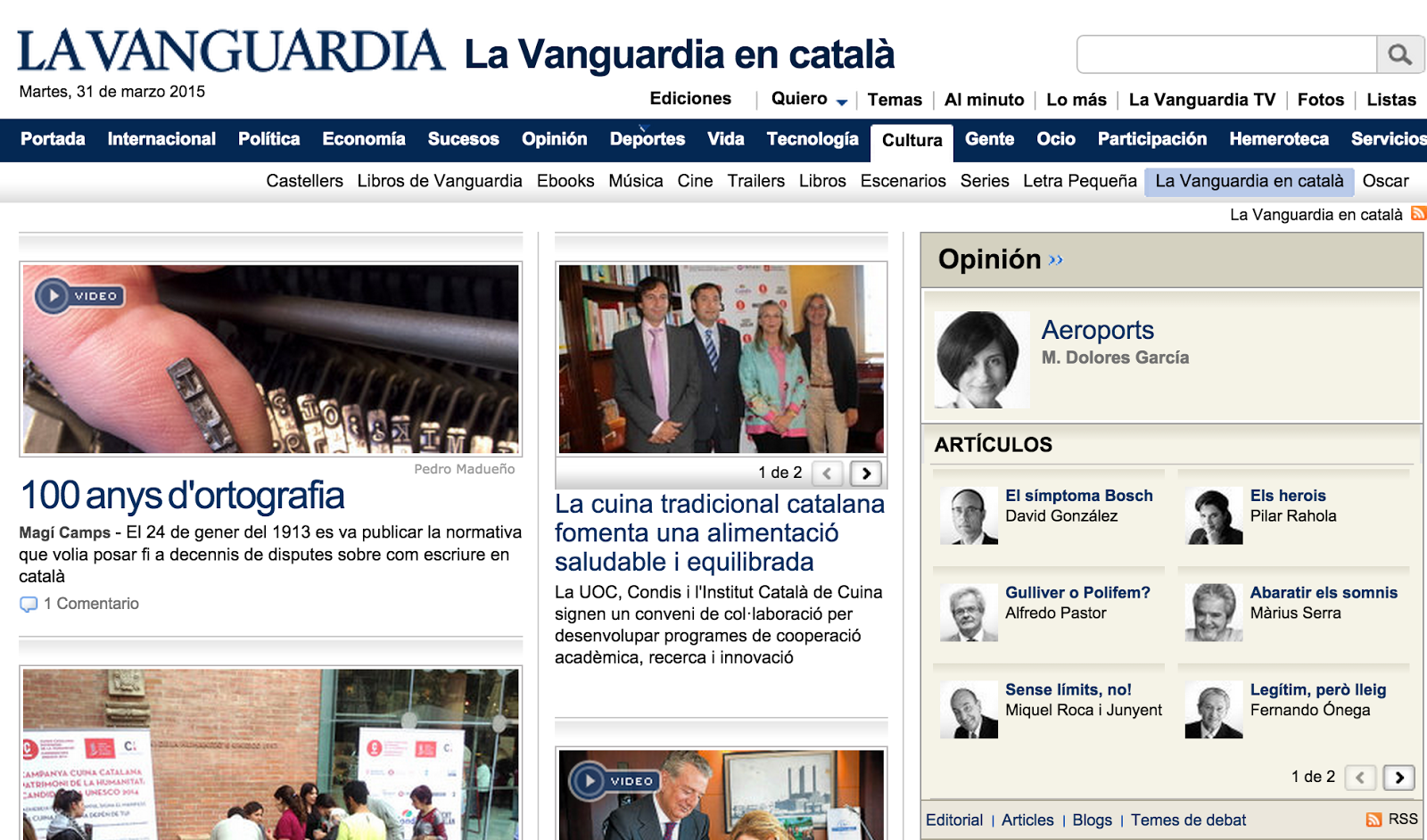
Front page of La Vanguardia, in Catalan BARCELONA, Spain -- Americans are used to traveling thousands of miles within their wide open spaces and hearing only English, with variations of accent and expression. But in France, Germany, Spain, and other parts of Western Europe, there are still regions of distinct languages and dialects preserved by geographic barriers, sedentary culture, and autonomous politics. So it should not have been a surprise to find that an international media event in Barcelona, to which I was invited to speak, was conducted not in Spanish but in Catalan, that Romance language of northeastern Spain and southern France. Even Spanish presentations were translated simultaneously into Catalan. (Disclosure: The sponsors paid me an honorarium and my travel expenses.) 600 media in Catalan But it was surprising to learn that there are nearly 600 media outlets in the Catalan language and that the government of the region has spent 181� million (link in Spanish) since 2008 ...