Posts

Sage advice from Spain's 'mastermind of startups'

Image
Antai Venture Builder nurtures startups. Photo by Caterina Barjau, in El Pais. Miguel Vicente was an industrial engineer with a hefty salary when he decided to throw it all overboard nine years ago and launch a coupon site. He gave some memorable quotes that should be heeded by any entrepreneur during an interview with Daniel Verdu of Spain's prestige daily newspaper, El Pais . "It's like the two pills in Matrix, you have two options: the blue one is for a secure paycheck at the end of the month, the support of a big group that will help you, nice vacations and weekends. And the red pill is the one for entrepreneurs: you won't have anything you had before and you won't even know if you will be around the next day. But you will be the owner of your destiny. That feeling, plus the notion that you cannot fail, makes you pull out the best of what you have inside." His first startup was called Lets-Bonus. He sold that and eventually he and two partners launched ...
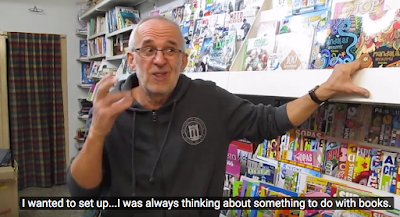
Newsstand owner adapts to survive media crisis

Image
Newsstand owner Jesus Erro: Publishers are fudging their sales numbers. PAMPLONA, Spain - Those who study the business of media tend to look at it from the perspective of journalists and publishers. But the owner of a newsstand in the heart of this provincial capital has a different point of view. Jesus Erro, 56, has owned and operated Caprichos Books and Stationery for the past 24 years. He has seen the good times and the bad. For the first decade or so, sales of magazines and newspapers -- about three fourths of his business -- were strong. But beginning in 2008, with the combination of the financial crisis and the Internet's impact on sales of print products, the business has gone down steadily. Versi�n en espa�ol "For small shops in this industry, it's very difficult to survive. A few years ago, when there was a favorable economic climate, everything was straightforward, more or less. You never expected to make a lot of money but you did expect to make a decent income...

'Take risks, learn from mistakes,' says film-maker

Image
Joff� spoke to several hundred students at the University of Navarra on Thursday . Film-maker Roland Joff� has a way of leading people on a mystical meditation to find out who they are and how they will communicate with the world. "The truth is that no one in this room actually knows where we are," he told about 400 students and professors Thursday at the University of Navarra School of Communication . "And if we don't know where we are, how on earth can we know who we are. And finding out who you are is all your journey, isn't it? "Communication is about finding out who you are and listening to other people and finding out who they are. And that's very beautiful." Joff� is best known for directing The Mission and The Killing Fields . But he holds a special interest for the University of Navarra audience because he wrote and directed There Be Dragons , a film about the founder of Opus Dei and the university, St. Josemar�a Escriv� de Balaguer . ( O...

How a musician views piracy and streaming

Image
In May I was in New York at an academic conference and had time to spend with my son, Patrick Breiner, a jazz saxophonist . I wanted to hear what he had to say about the economics of the music business from his perspective. He ended up talking more about relationships than economics. Patrick says that in the digital world, the connection between the artist and their work is intangible. So the act of downloading the work for free "doesn't feel the same as taking a physical thing from a store or a person." "When you download content for free, at least in my experience, my relationship to that content is cheapened." Patrick, 32, says he has downloaded lots of material for free from libraries and other sites, and never listens to it. On the other hand, the music he has bought and literally invested in -- whether from streaming services, CDs, or vinyl albums -- "I listen to all the time." Read more �

"It's not students with smartphones but professors' teaching methods that are to blame"

Image
I want to share with you my translation of a blog post (Spanish) by my friend and colleague Jose Luis Orihuela, a professor at the University of Navarra, author, and keynote speaker. Orihuela is addressing a problem that faces many teachers and professors: they say their students are distracted by all the media on their smartphones and are not paying attention in class. Don't blame the students, he says. Blame the professors . "It has to be said again: the problem is not that the student is distracted by technology but that the professors have to change their methods and the content of their teaching. "It's easy to place the blame on the students and their devices; the hard thing to do is redesign education to adjust to a culture of connectivity. You can't teach against the culture of the students. You have to build on top of it." He mentioned a well publicized column by a professor in Uruguay who decided to throw in the towel rather than fight against stu...

'Distributed content' expands reach, weakens influence of news organizations

Image
The following is an excerpt from my chapter of a book on digital news media that will be published shortly, in Spanish. Among the most important developments in digital journalism in 2015 was the emerging practice of creating, distributing, and monetizing news known as " distributed content ". Bell: 'Facebook is eating the world.' What it means: news media organizations hand over their content to platforms like Facebook without linking back to their own websites so that smartphone users can get nearly instant access to the content without having to wait five to 10 seconds for it to display -- an eternity for impatient mobile consumers. Versi�n en espa�ol Snapchat was the first platform to stake a claim in this new territory of competition when it launched its Discover channel in January of 2015. Facebook followed in June with its � Instant Articles �, and others such as Google, Instagram, and Apple quickly jumped on the bandwagon. These social and technological pl...

Forget about the big numbers; go for loyalty, trust

Image
Anyone who has studied the metrics of the internet in any detail knows about the Big Lie : those big numbers of total users and page views that everyone relies on are practically meaningless . More than half of the visitors to websites stay for less than 15 seconds . Three-fourths of the users of the most important news sites in the U.S. visit only once or twice a month . How can you even consider them users? Half of the internet users in 26 countries are getting their news through social media rather than the originating news sites themselves, according to the Reuters Institute's Digital News Report 2016. 43% of social media users don't know where the stories they read originally appeared . Jon Slade of the Financial Times In other words, millions of clicks or millions of users are not an indication of trust in a particular news brand or loyalty to that brand. We need new metrics, better metrics. Versi�n en espa�ol So it was heartening to see this reality affirmed by of one ...